

Humanoid Robot Market Witnessing Rapid Expansion with 30.4% CAGR Driven by AI and Automation Advancements
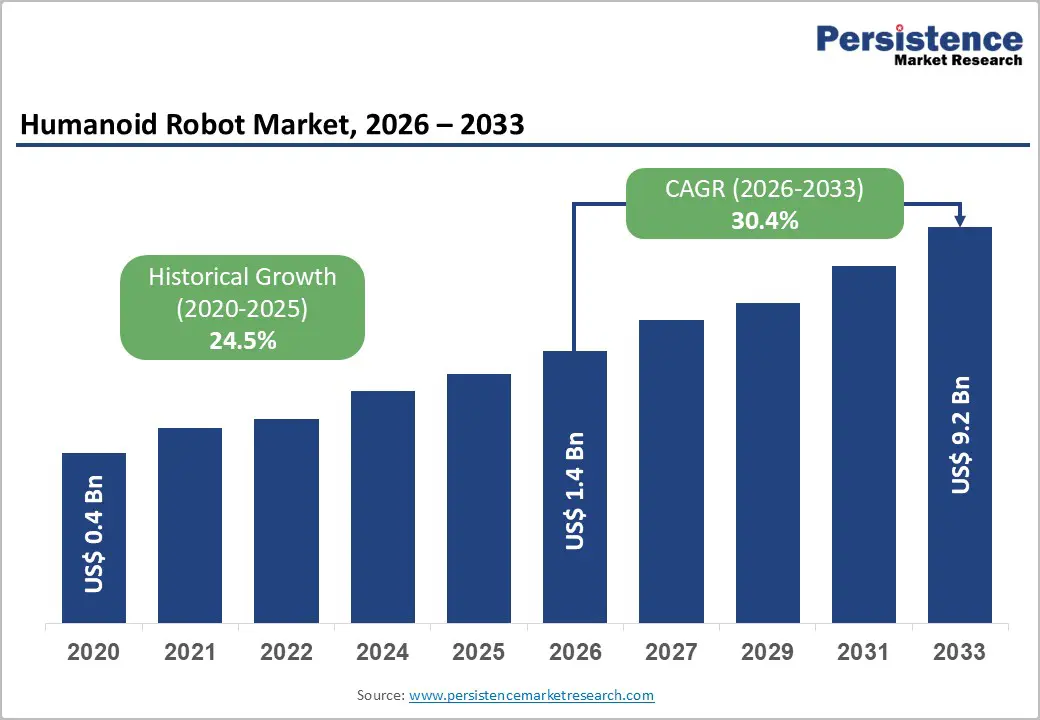
Humanoid Robot Market Size and Trends Analysis
Rising AI integration, automation demand, and expanding service applications drive rapid growth in the humanoid robot market.
BRENTFORD, LONDON, UNITED KINGDOM, April 30, 2026 /EINPresswire.com/ -- The humanoid robot market is rapidly evolving as advancements in artificial intelligence, machine learning, and robotics engineering continue to reshape human-machine interaction. Humanoid robots, designed to mimic human appearance and behavior, are increasingly being deployed across industries such as healthcare, retail, education, and manufacturing.
The global humanoid robot market is likely to be valued at US$ 1.4 billion in 2026 and is projected to reach US$ 19.6 billion by 2033, growing at a CAGR of 30.4% between 2026 and 2033. This exceptional growth is driven by rising investments in robotics research, increasing use of AI-powered systems, and expanding applications in service industries. The service robot segment leads the market due to its wide use in customer service, healthcare assistance, and hospitality. Geographically, Asia Pacific dominates the humanoid robot market, supported by strong manufacturing capabilities, rapid technological adoption, and significant investments in robotics innovation across countries like Japan, China, and South Korea.
Get Free Sample Now: https://www.persistencemarketresearch.com/samples/36260
Key Highlights from the Report
➤ The global humanoid robot market is valued at US$ 1.4 billion in 2026 and is projected to reach US$ 19.6 billion by 2033, growing at a CAGR of 30.4%.
➤ Increasing integration of artificial intelligence and machine learning is significantly enhancing humanoid robot capabilities across industries.
➤ Rising demand for automation in service sectors such as healthcare, retail, and hospitality is accelerating market growth globally.
➤ Asia Pacific leads the market due to strong robotics manufacturing ecosystems and government support for innovation.
➤ Technological advancements in sensors, mobility systems, and natural language processing are driving adoption of humanoid robots.
➤ Growing investments from private companies and research institutions are expanding commercial applications of humanoid robotics.
Market Segmentation
By Component Type
• Hardware
• Software
• Services
By Locomotion Type
• Bipedal Humanoid Robots
• Wheeled Humanoid Robots
• Hybrid
By Level of Autonomy
• Fully Autonomous
• Semi-Autonomous
• Tele-Operated
By Industry
• Industrial & Logistics
• Commercial & Public Services
• Healthcare & Assisted Living
• Defense & Security
• Residential / Consumer
• Research & Education
• Misc.
By Region
• North America
• Europe
• East Asia
• South Asia Oceania
• Latin America
• Middle East & Africa
Request For Customization: https://www.persistencemarketresearch.com/request-customization/36260
Regional Insights
North America
North America represents a significant market for humanoid robots due to strong technological infrastructure and high investment in research and development. The presence of leading technology companies and robotics startups is driving innovation in the region. Increasing adoption of automation in industries such as healthcare and retail is further supporting market growth. Additionally, demand for advanced robotics solutions to address labor shortages is contributing to the expansion of the humanoid robot market in North America.
Europe
Europe is witnessing steady growth in the humanoid robot market driven by advancements in robotics engineering and supportive government initiatives. Countries such as Germany, France, and the UK are investing in robotics research to enhance industrial productivity and innovation. The region is also focusing on integrating humanoid robots into healthcare and service sectors to improve efficiency and service quality. Growing emphasis on automation and digital transformation is expected to further boost market demand across Europe.
Asia Pacific
Asia Pacific dominates the humanoid robot market due to rapid industrialization and strong government support for robotics development. Countries like Japan and China are at the forefront of humanoid robot innovation, with extensive use in manufacturing and service industries. The region benefits from a well-established electronics manufacturing ecosystem, which supports large-scale production of robotic components. Increasing investments in AI and robotics research are expected to maintain Asia Pacific’s leadership position in the global market.
Market Drivers
The increasing demand for automation across industries is a major driver of the humanoid robot market. Businesses are seeking advanced solutions to improve efficiency, reduce operational costs, and enhance productivity. Humanoid robots offer the ability to perform repetitive and labor-intensive tasks with high precision and consistency. In service sectors, these robots improve customer experience by providing interactive and personalized assistance. The growing need for automation in response to labor shortages and rising labor costs is further accelerating the adoption of humanoid robots.
Another key driver is the rapid advancement of artificial intelligence and robotics technology. Innovations in machine learning, computer vision, and natural language processing are enabling humanoid robots to interact more effectively with humans and adapt to changing environments. Increased investment from both public and private sectors is fueling research and development in robotics. These technological advancements are expanding the capabilities of humanoid robots, making them suitable for a wide range of applications, from healthcare assistance to industrial operations.
Market Opportunities
The humanoid robot market presents significant opportunities as industries continue to embrace automation and digital transformation. The healthcare sector, in particular, offers immense growth potential, with humanoid robots being used for patient care, rehabilitation, and elderly assistance. As the global population ages, the demand for robotic caregivers is expected to increase, creating new opportunities for market expansion.
Technological advancements are also creating new opportunities for innovation in the humanoid robot market. The integration of advanced AI systems, cloud computing, and IoT technologies is enabling robots to become more intelligent and connected. These innovations are improving the efficiency and functionality of humanoid robots, making them more attractive to businesses.
The key players studied in the report include:
• SoftBank Robotics Group
• PAL Robotics
• Figure AI
• Agility Robotics
• UBTECH Robotics Corp. Ltd.
• Apptronik
• ROBOTIS Co. Ltd.
• Boston Dynamics
• Hanson Robotics
• YuShu Technology Co.Ltd. (UNITREE)
Buy Now: https://www.persistencemarketresearch.com/checkout/36260
Future Opportunities and Growth Prospects
The humanoid robot market is expected to experience transformative growth driven by continuous advancements in AI and robotics technologies. Increasing adoption across healthcare, retail, and industrial sectors will create sustained demand for humanoid robots. As innovation continues and costs gradually decline, humanoid robots are likely to become more accessible to a wider range of industries. This evolution will open new growth avenues and reinforce the market’s long-term expansion trajectory.
Persistence Market Research
Persistence Market Research Pvt Ltd
+1 646-878-6329
email us here
Visit us on social media:
LinkedIn
Instagram
Facebook
YouTube
X
Legal Disclaimer:
EIN Presswire provides this news content "as is" without warranty of any kind. We do not accept any responsibility or liability for the accuracy, content, images, videos, licenses, completeness, legality, or reliability of the information contained in this article. If you have any complaints or copyright issues related to this article, kindly contact the author above.
